
Books
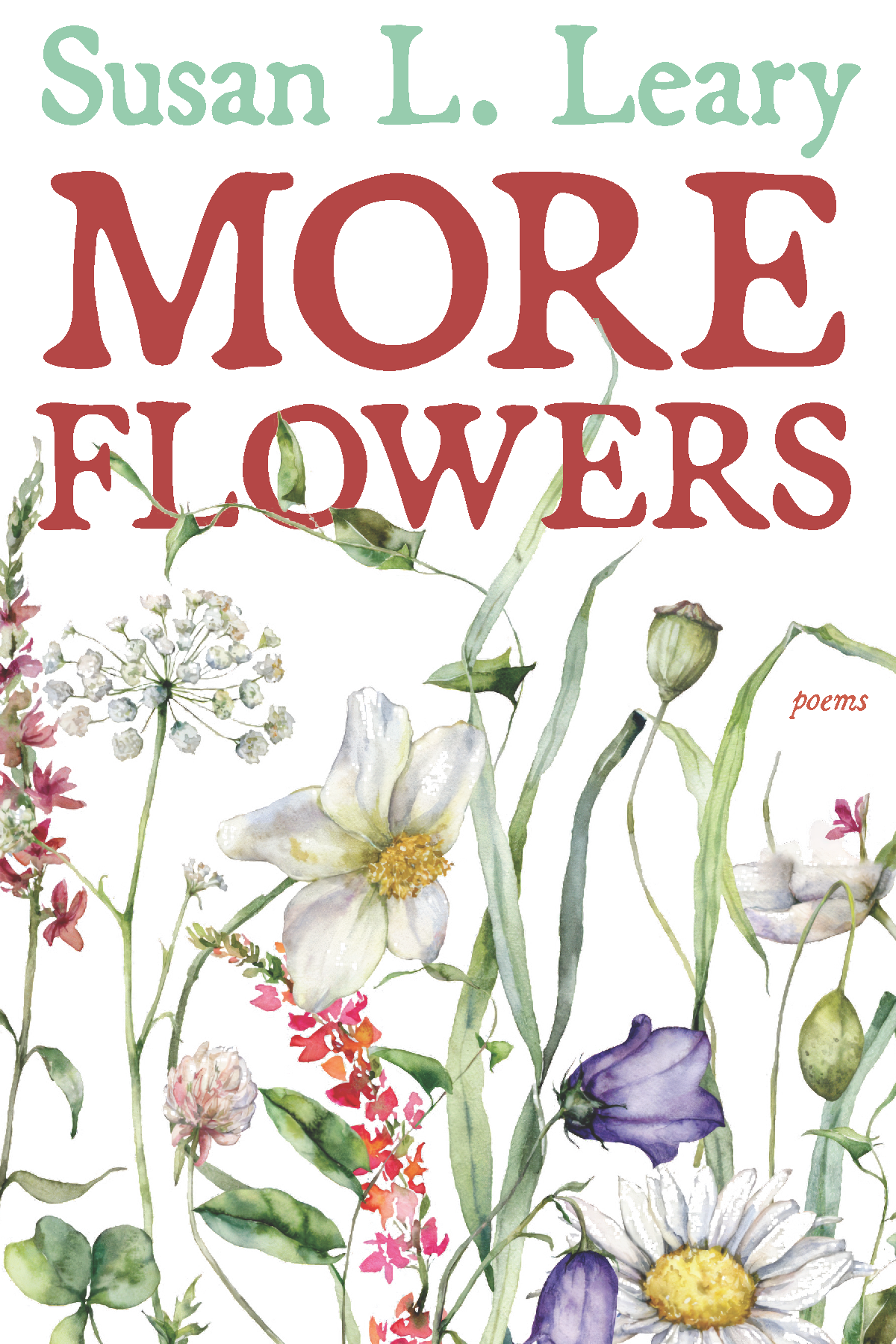
More Flowers
With lyrical acuity, philosophical insight, and deep reverence for girlhood, womanhood, and the wildly intelligent spirit that is the female imagination, Susan L. Leary’s newest collection, More Flowers, unfolds as self-interrogation, tribute, and template for survival. At its center is the figure of the mother, whose fierce brutality in navigating the world offers the speaker ambition, tender affirmation, and a necessary understanding of her origins. In particular, images of nature abound: at each turn, animals, weather patterns, changing landscapes, and the strength and fragility of flowers mirror life’s emotional complications and teach the will to outlast. Most of all, these poems celebrate the idea of excess, that sensation of always wanting more—more time, more meaning, more love, more flowers—because despite every trial and every sadness, this life, quite simply, is never enough.
Allison Adair, author of The Clearing
Quiet tensions drive this collection: the ox walking on ice and the voice box buried in a meadow, frayed wings grasping at the updraft. Leary offers More Flowers, pulling us close enough to inspect paradox, awareness, and the limiting roles women must play, all the while asking, “What, of any of this, is holy?” But these poems make a map toward a new kind of survival, warning us not to feed the stray cat, as “her hunger is what keeps her alive.” In the distance, Leary promises, is the waft of a glorious perfume—we’re simply asked to be careful as we advance, to remember “what the flowers have endured, before they were flowers.”
Kathryn Bratt-Pfotenhauer, author of BAD ANIMAL
If books were flowers, distinct and awesome in their beauty, Susan L. Leary has given us a bouquet of wonders. More Flowers toes the line between fiction and unrequited love, the Creator and the Mother: ruthless and meticulous constructions all. In this collection, girlhood is a trial by fire, a bullet aimed at the head, a girl rubbernecking the scene of herself, counting herself dead. With lyric deftness, Leary’s poems in More Flowers bristle with beasts: the swan, the ox, a bird named Ego, and at the center of it all, the animal woman folded in on herself while God watches, impassive and inscrutable as His miracles. Leary’s speaker is twin to that of W.B. Yeats, going out in search of her own face and yearning for a world uninterrupted by the illusory safety of marriage and the societal pressures to have children, more girls churned out into the charnel house. Leary’s poems are dark; good. To examine girlhood is to live in its inherent darkness: feathers pulled from the wings of birds; mothers apologizing to their girls through broken mirrors; the heads of flowers hanging low over their snapped necks.
Cynthia Marie Hoffman, author of Exploding Head
More Flowers is a celebration of girlhood and womanhood, richly complex, built from equal parts delicateness and fierce survival. Like “a girl stepping in & out of her wound costume,” Susan L. Leary’s poems affirm the many ways we bear and let go of grief. This collection is masterfully synergistic, struck through with precise, echoing images—animals, flowers, bones, blades—that both intensify and surprise. A wolf mother feeds on flowers, “the froth of tulips dusting her snout;” a human mother wraps the stems of lilacs “as if the limbs of angels.” Read this book for its beauty, its brutality, and its hard-won, revelatory blooms.
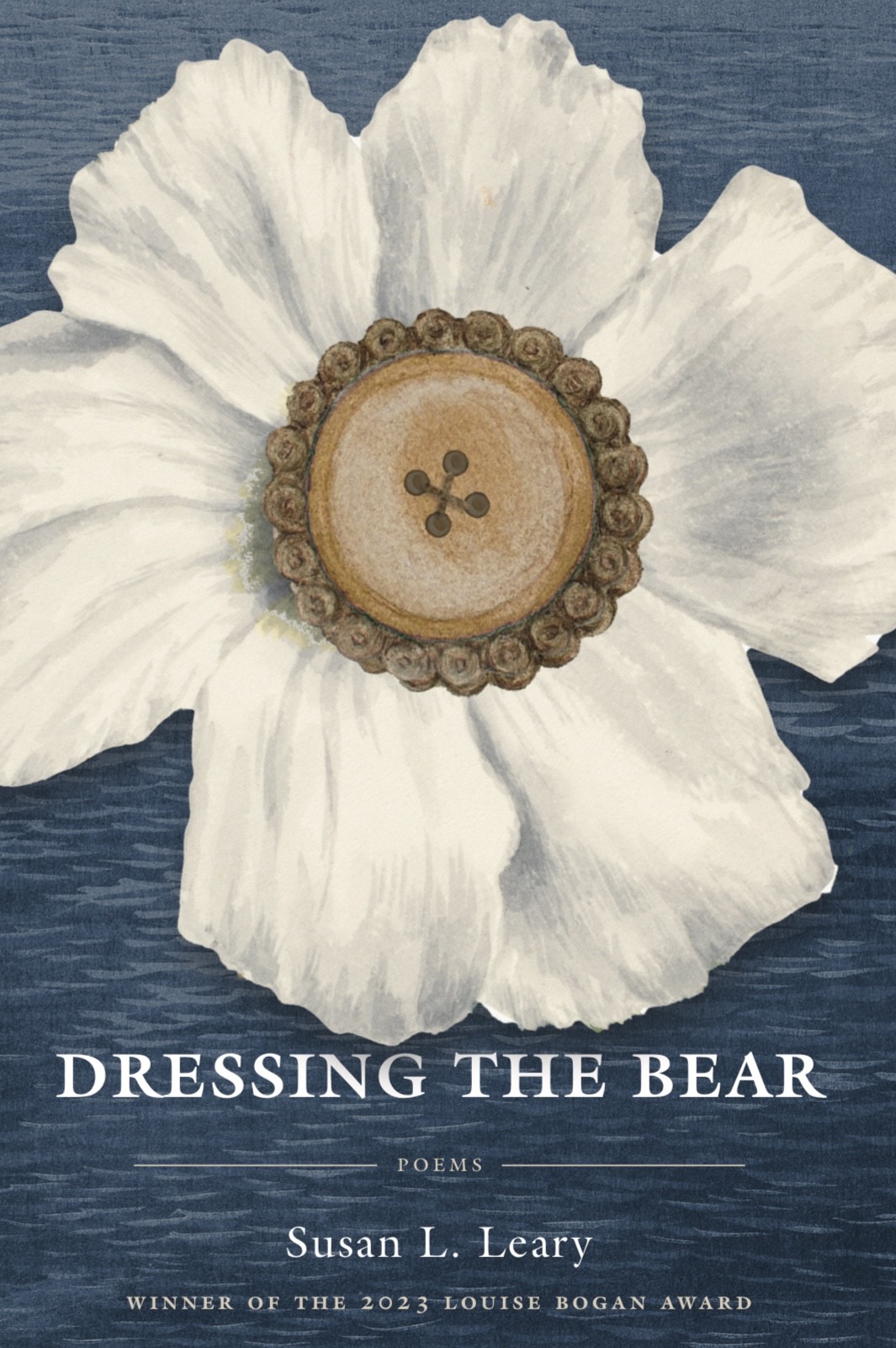
Dressing the Bear
Winner of the 2023 Louise Bogan Award, Susan L. Leary’s Dressing the Bear is a collection of poems composed in the wake of her brother’s passing that explores the themes of love, loss, grief, longing, and addiction. Many of these poems come in the form of a direct address to her brother: how to speak to the dead now? How to convince herself of her brother’s continuation in the next life? Of equal concern is the matter of love: what kind of love exists between a brother and a sister, between the addict and those who love him? More than anything, however, these poems seek to unravel her brother’s wounds, to understand his pride and shame as a result of addiction, as well as to honor and illuminate his unique wisdom-his charm, his humor, and his creativity-that on even his most difficult days was always there.
Kimberly Blaeser, Judge, author of Ancient Light & Wisconsin Poet Laureate, 2015-2016
From the pen of one who has known loss, the fearless poems in Dressing the Bear look from many angles at how the “world . . . takes you hostage.” But this is not a book about grief; it is the act itself. The poet grieving, laments the limits of language even as Leary pushes them. Among the tangles of remembering and enough blame to go around, Leary invites us to moments of transcendence: her brother “stretching the ghost of his boyhood into a god,” “a holiness at the end of day . . . like waning light looking back at me,” and “birds . . . washing their feathers with water from our eyes.” Find in these poems an ache much like the one you harbor, a search for “afterglow,” and small promises of new light.
Jessica Cuello, author of Yours, Creature
There is nothing faint-hearted in Susan L. Leary’s, Dressing the Bear, a book-length elegy to her dead brother. These are poems made from grief, from the “mercy of animation,” from bones, wings, water, and a “dress sand-colored with splotches of blue.” Leary writes directly into the pain of her brother’s addiction, incarceration, and death. She does not seek ease; she seeks the grief itself and asserts that “a body is built to be antagonized by God.” Yet, this gorgeous book, that made me weep, teaches that the only way out of pain is through, and Leary moves through: fearlessly, with beauty.
Matt Rasmussen, author of Black Aperture, winner of the Walt Whitman Award / Finalist for the National Book Award
Grief is deeply strange and disorienting and life altering. This collection of poems, dedicated to a lost brother, unfolds the sorrow we are often taught to bottle up. In this impressive book, Leary balances on that wary edge between mourning and imagination, between moving forward and rewinding the past. These elegies absorb and concede the finality of death while miraculously keeping the beloved brother present and pulsing.
A Buffet Table Fit for Queens
Winner of the Washburn Prize, Susan L. Leary’s digital chapbook, A Buffet Table Fit for Queens, explores the innovative ways in which women invent their own vocabularies to cultivate a communal love that dismantles and transcends a world that continually seeks to regulate their bodies and voices. It is a collection in praise of the woman’s imagination, which is keen and beast-like in its subversiveness, as well as an exercise in what the poet calls a “practical mythology,” a visionary ethos that draws on myth and folklore to create an experience for women that is both individually and collectively affirming.

Laura Lee Washburn, Judge
“The Language of Women” reinforces and expands on a stance: in this poem and in this book, we are talking about language, this history of people who may have the ability to conceive, and we are talking about how words in men’s mouths have transformed women from full human beings to something less: “not even Mary can avoid the advances of God. & so every woman is a girl. Young girl. Servant girl.” Read A Buffet Table Fit for Queens, and you’ll own new ways of seeing our world. To quote Audre Lorde, “This is poetry as illumination.”
Alexa Doran, author of DM Me, Mother Darling
Who benefits from the idea that life is linear? Susan L. Leary’s A Buffet Table Fit for Queens subverts the patriarchal origin story which clings to cause and effect, and instead invites us to forsake narrative for truth. Leary teases us towards temporal freedom, reminding us that death is “as vague as the color blue,” that every girl is “born a ghost”, and that for women it’s always winter. Leary helps us envision the boundlessness of existence, an existence where no woman is expected “to ration a nation’s / petals,” an existence where “Mary can avoid the advances of God.” Whether enjambed in a prose poem or floating in amniotic white space, Leary’s lines command their own plane. Luscious, intimate, and cutting, this collection has lungs. Let it change even the air you breathe.
Sheree La Puma, author of Broken: Do Not Use
Susan L. Leary’s new book, A Buffet Table Fit for Queens, is evocative, fierce, and unfailingly beautiful. Bearing witness to the female identity from conception to selfhood, it is a journey through a transactional world. “The unholy histories of a thousand dresses suddenly clamoring against skull & bone.” Leary creates a masterful mix of excavation and longing that savage preconceived roles. These poems are born in “The Language of Women,” yet haunt us with their marginalized voices. “A wolf howls & Mary is the chosen one. A wolf howls & in the back of a woman’s mind, not even Mary can avoid the advances of God.” Leary doesn’t leave us in the trenches, however. Her poems grow and build toward strength and discovery. “In turning from the mirror, I see my mother, seeing me as I have so badly wanted to be seen.” And it is in this remembered space that A Buffet Table Fit for Queens encourages the reader to let go and reexamine the conception of who we are and how we got there.

Contraband Paradise
Susan L. Leary’s Contraband Paradise is a collection of poems structured around a series of X-ray impressions that explores what can only be described as “the marvelous clairvoyance of a body that believes in its own ability to live.” It is a book that explores the ways in which we thieve joy, in which we live affirmatively, and astonishingly, amidst all that we inherit. More than anything, it is a book that juxtaposes the beauty and rupture that characterizes the world, this “contraband paradise,” so to speak.
Chelsea Dingman, author of Thaw
“The opposite of anything is the thing itself—” states the speaker in “A Perfect Animal.” This statement echoes the tensions between subjectivity and objectivity, the sentence and the line, the self and the body, in this complex collection. Through the lens of the body, Leary’s aching poems deftly examine the fierce beauty of survival, love, memory, and all that will not be held, except in astonishment.
Melissa Ostrom, author of The Beloved Wild
Contraband Paradise is an astonishment, a book that invites us to look, then look again, and see the luminous in the harrowing. “Are you surprised, then, when I tell you joy is only sadness from the outside looking in?” Leary asks, and like this and in other ways, her words reposition us, awaken and disorient us, gently, with humor and love. Oh, the love in these poems, tender, difficult, attentive, necessary—to counter the body’s perverse autonomies and limitations, to ameliorate pain, to mine joy.
Susan Lewis, author of Zoom and editor of Posit
In Susan L. Leary’s Contraband Paradise, “even dust has a / capacity for gleaming.” Informed by the poet’s clear eye, exquisite ear, and evident faith, these poems reveal “the sky joyed with its own steadied abundance” even as they confront the need to “part & parcel our complicated selves” when “each day is a crash course in survival.” To read these gorgeous poems is to be gratefully persuaded that “the opposite of cursed is to live.”
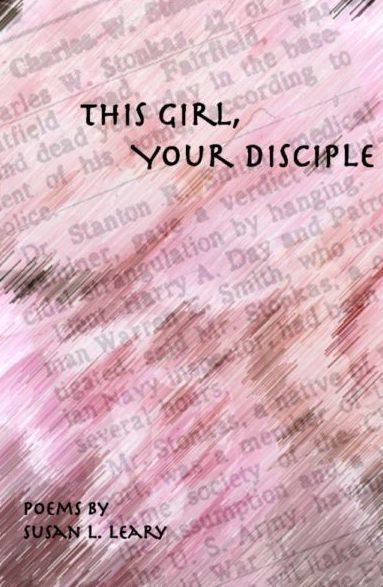
This Girl, Your Disciple
Finalist for The Heartland Review Press Chapbook Prize and semi-finalist for the Elyse Wolf Prize, This Girl, Your Disciple explores the history of a family suicide kept secret for almost 50 years.
Maureen Seaton, author of Sweet World
Some poets are lightbearers. Some poems possess the grace to heal. Susan L. Leary’s This Girl, Your Disciple is the luminous account of a terrible death; the family afterward wrestling with their angels, both dark and light; and the young writer herself appearing before us in brave strokes. The poems are stunning in their devotion, healing in the way they bear witness. This is the divinity of perspective…says the poet. The poem I want to write is the one I cannot. Here is a remarkable first book for all of us to breathe in: life-changing in its courage and in its beauty.
Philip Elliott, Editor-in-Chief of Into the Void and author of Hunger & Hallelujahs
This Girl, Your Disciple begins with the life cycle of a blood-colored rose mallow from blossoming to withering end, “conscious, in the last breath, / of something missed.” What is missed is what Susan L. Leary laments in this excellent collection of poetry as she explores the legacy of her grandfather’s suicide, tracing the journey of her discovery and the need to understand. These poems of startling energy and elegance make up a book of questions that asks one in particular: Why do the people we love leave us in the ways they do? It is a question, of course, that cannot be answered, but through gorgeously musical language and vivid imagery, Leary ensures that, while understanding may not always materialize, her grandfather does, memorialized “forever into blood-red roses.”
Jaswinder Bolina, author of Phantom Camera
Susan L. Leary’s gorgeous, lyric poems have the weight of history in them, of many histories, the dark ones of family but also of country and war, of PTSD and suicide. Somehow in that darkness, Leary finds a brightness of candor and a brilliance of description. Her keen eye discovers profundities where a lesser writer might find only tragedy. In her opening poem “The Rose Mallow,” she details, “The powdery wings of a thousand / moths // falling / asleep at the stalk. The flower shriveling so as / to feel for itself, // conscious, in the last breath, / of something missed. // As if to say, / there is the muddied earth, // there is the dead / rain, // but what of my body / will I remember?” This writer misses nothing, and This Girl, Your Disciple is the kind of collection you will most certainly remember.
 Susan L. Leary